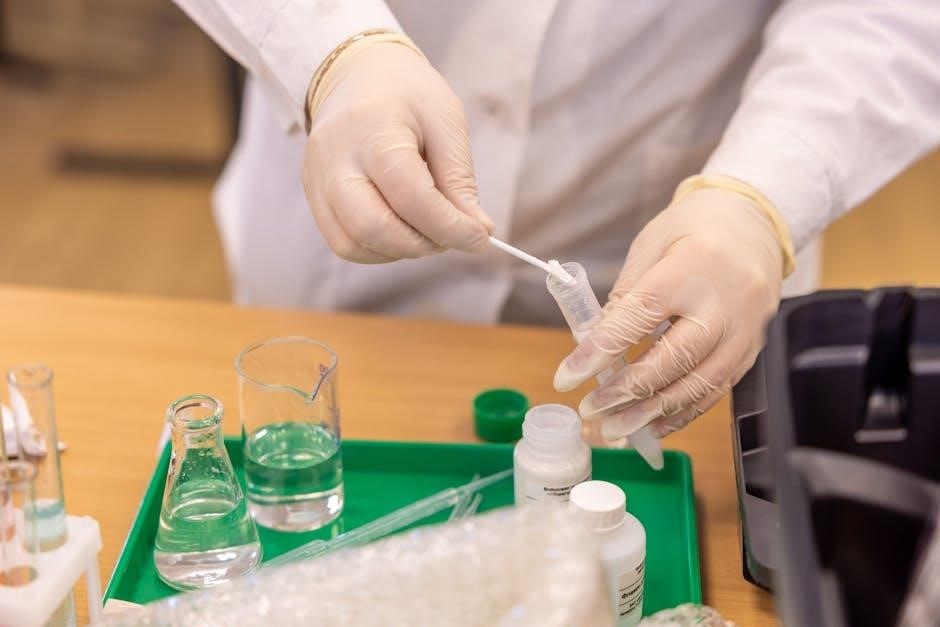
This manual‚ licensed under Creative Commons Attribution‚ enhances student learning and provides a comprehensive understanding of general chemistry principles.
It fosters science practice proficiency‚ a key outcome for undergraduate students‚ ensuring a robust educational experience.
Purpose of the Lab Manual
This General Chemistry Lab Manual serves as a crucial companion to the lecture course‚ bridging theoretical concepts with practical application. Its primary purpose is to cultivate a deeper‚ more intuitive grasp of chemical principles through hands-on experimentation.
Aligned with Creative Commons Attribution licensing‚ this resource aims to enhance student learning by providing clear‚ concise instructions for each experiment. It’s designed to foster scientific practice proficiency – a vital learning outcome – by emphasizing observation‚ data analysis‚ and critical thinking.
Furthermore‚ the manual prepares students for future scientific endeavors by instilling proper laboratory techniques and safety protocols. It aims to provide a holistic view of the field‚ enabling students to confidently tackle complex chemical challenges.
Safety Regulations and Procedures
Prioritizing safety is paramount in the chemistry laboratory. This manual outlines essential regulations and procedures to minimize risks and ensure a secure learning environment for all students.
All personnel must adhere to strict guidelines regarding personal protective equipment (PPE)‚ including safety goggles‚ lab coats‚ and appropriate footwear. Proper handling and disposal of chemical waste are also critical‚ following established protocols to prevent environmental contamination.
Students are expected to familiarize themselves with the location of safety equipment‚ such as fire extinguishers and eyewash stations. Any accidents or incidents‚ no matter how minor‚ must be reported immediately to the instructor. A commitment to responsible laboratory practices is essential.
Required Materials and Equipment
Successful completion of experiments necessitates specific materials and equipment. Students are required to obtain a laboratory notebook for recording observations‚ data‚ and calculations – a crucial component of scientific practice.
Essential equipment includes a variety of glassware (beakers‚ flasks‚ graduated cylinders)‚ balances for accurate mass measurements‚ and heating devices like hot plates. Access to common chemical reagents will be provided‚ but students may occasionally need to bring specific items as indicated by individual experiment instructions.
Familiarity with the proper use of each item is vital. Detailed guidance will be offered throughout the course‚ emphasizing responsible handling and maintenance of all laboratory resources.
Basic Laboratory Techniques
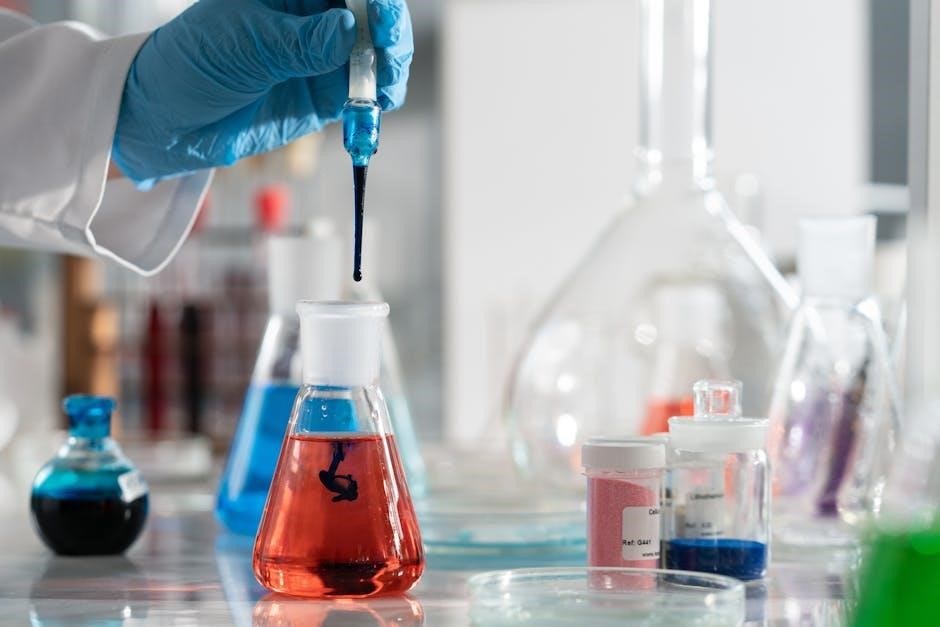
Mastering fundamental techniques is crucial for accurate experimentation. This section details proper procedures for handling equipment and performing essential lab skills safely.
Proper Use of Glassware
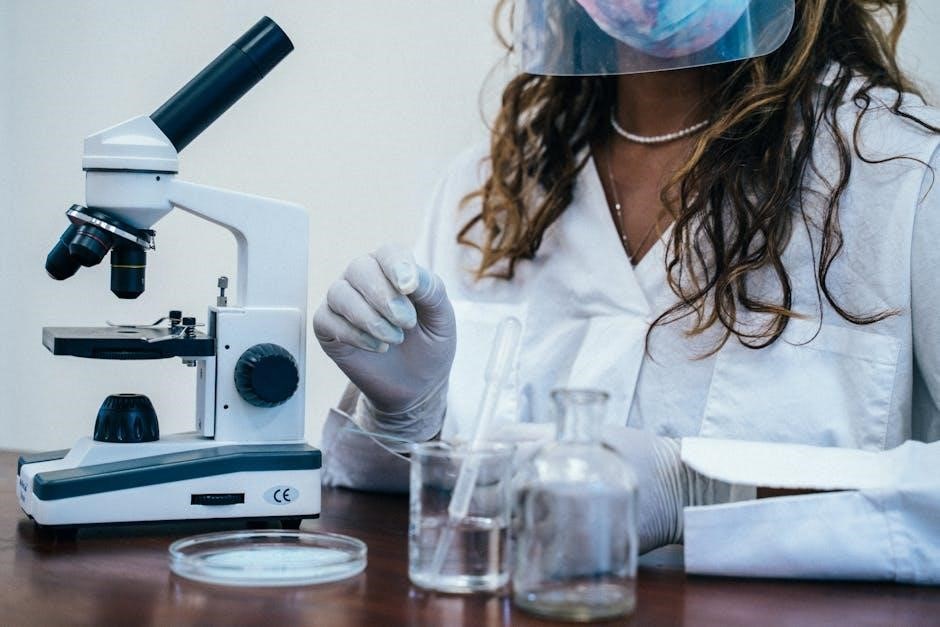
Glassware is fundamental to any chemistry laboratory‚ requiring careful handling and understanding of its limitations. Beakers are ideal for mixing and approximate volume measurements‚ while Erlenmeyer flasks excel in swirling without spills‚ useful for titrations.
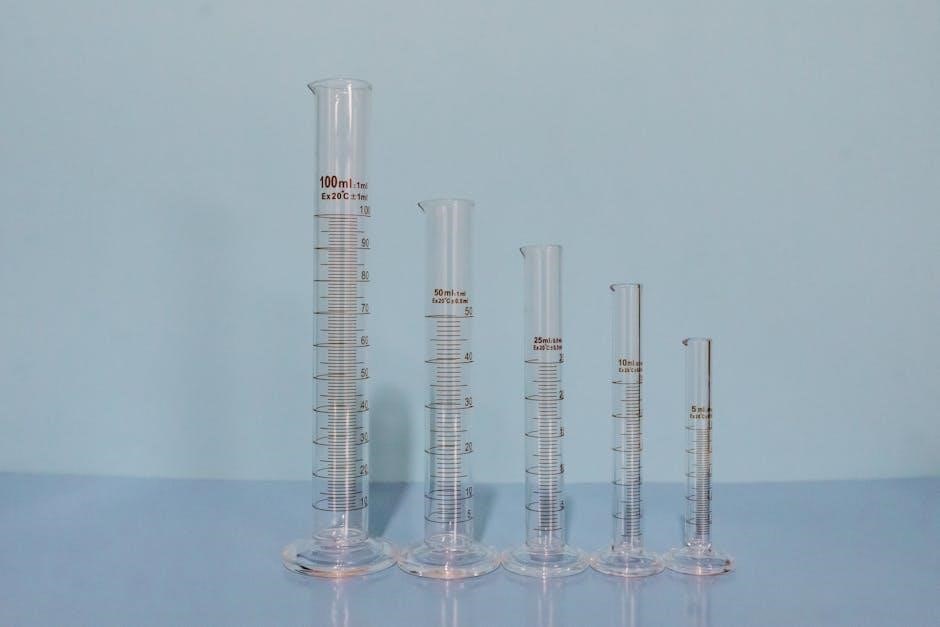
Graduated cylinders provide more precise volume measurements‚ and volumetric flasks are designed for preparing solutions of exact concentrations. Test tubes are versatile for small-scale reactions‚ but should never be heated directly.
Always inspect glassware for cracks or chips before use‚ discarding damaged items safely. Proper cleaning with appropriate detergents is essential‚ followed by thorough rinsing with distilled water. Avoid abrupt temperature changes to prevent thermal shock and breakage‚ ensuring a safe and productive lab environment.
Measuring Techniques: Volume and Mass
Accurate measurements are crucial in chemistry. For volume‚ utilize graduated cylinders‚ pipettes‚ and burettes‚ reading the meniscus at eye level for precision. Remember that pipettes are designed to deliver a specific volume‚ while burettes allow for variable dispensing during titrations.
When measuring mass‚ employ analytical balances for high accuracy‚ ensuring the balance is properly calibrated. Always tare the balance with the container before adding the substance.
Record all measurements with appropriate units and significant figures. Understanding the limitations of each instrument and practicing proper technique will minimize errors and ensure reliable experimental results‚ vital for quantitative analysis.
Filtration and Decantation
Filtration separates solids from liquids using filter paper and a funnel. Proper technique involves folding the filter paper correctly and ensuring a complete seal to prevent solids from bypassing the filter. Vacuum filtration speeds up the process‚ utilizing reduced pressure.
Decantation carefully pours off a liquid‚ leaving a solid residue behind. This is useful for quick separations when a clear separation exists between phases.
Both techniques require careful observation to avoid loss of product. Rinse the original container and the filter paper with a small amount of solvent to ensure complete transfer of the desired substance‚ maximizing yield and purity.
Heating and Cooling Methods
Heating in the chemistry lab utilizes hot plates‚ Bunsen burners‚ and oil baths. Hot plates provide even heating‚ while Bunsen burners offer higher temperatures but require caution. Oil baths maintain consistent temperatures for sensitive reactions.
Cooling often involves ice baths or refrigerated cooling circulators. Ice baths are simple and effective for lowering temperatures‚ but require monitoring to maintain desired levels. Cooling circulators provide precise temperature control.
Always use appropriate safety measures‚ including heat-resistant gloves and eye protection. Gradual heating and cooling prevent thermal shock to glassware‚ ensuring safe and successful experiments.
Qualitative Analysis
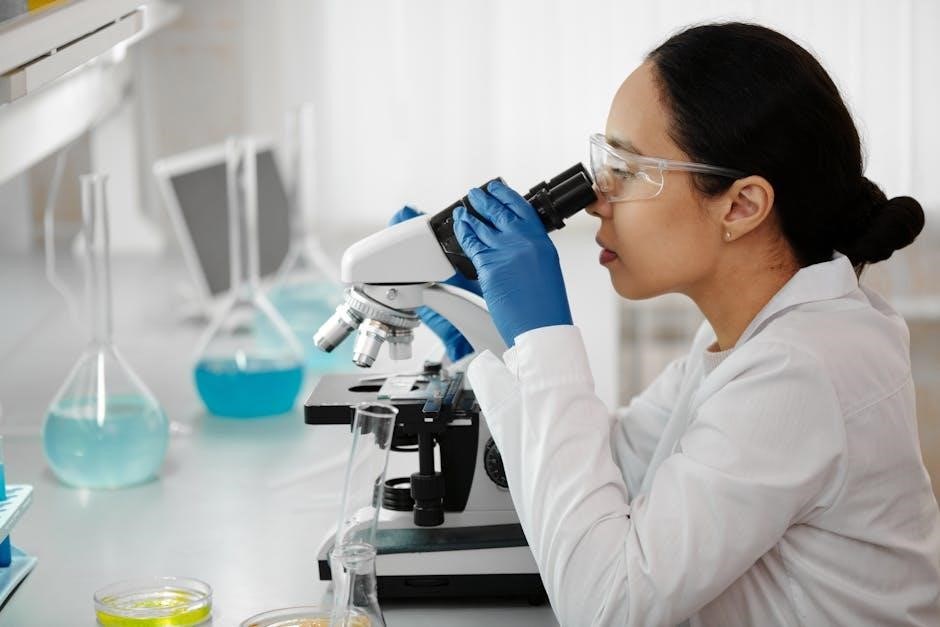
This section focuses on identifying substances through observation‚ employing techniques like flame tests‚ precipitation reactions‚ and ion detection methods for analysis.
Identifying Common Ions
This experiment introduces techniques for identifying common cations and anions present in aqueous solutions. Students will learn to utilize selective precipitation reactions‚ leveraging differences in solubility to isolate specific ions;
Careful observation of precipitate colors and formations is crucial for accurate identification. The process involves adding specific reagents to unknown samples‚ observing resulting changes‚ and comparing those observations to known characteristics of various ions.
Emphasis will be placed on understanding the underlying chemical principles governing these reactions‚ including solubility rules and the formation of insoluble compounds. Proper waste disposal procedures‚ adhering to safety regulations‚ are paramount throughout the experiment.
Detailed record-keeping of observations is essential for drawing valid conclusions.
Flame Tests for Metal Ions
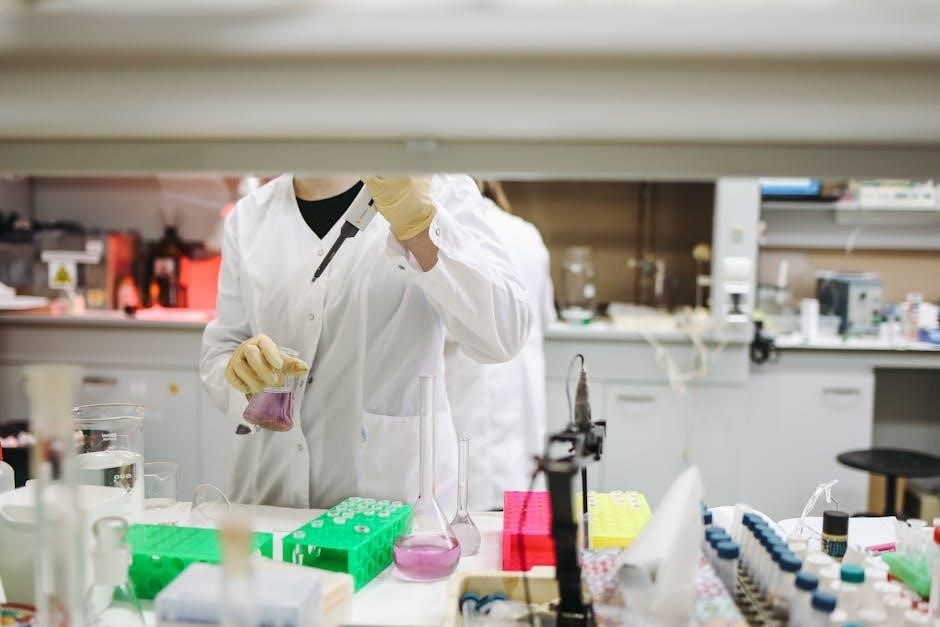
This experiment explores the characteristic colors produced when metallic ions are heated in a flame. Each metal ion emits a unique wavelength of light upon excitation‚ resulting in distinct flame colors – a fundamental principle of atomic emission spectroscopy.
Students will carefully observe and record the flame colors produced by various metal salt solutions. Proper technique involves cleaning the platinum or nichrome wire loop before each test to avoid contamination and ensure accurate results.
Understanding the relationship between electron configuration and emitted light is key. Safety precautions‚ including wearing appropriate eye protection‚ are essential when working with open flames and chemical substances.
Accurate identification relies on careful observation and comparison to known standards.
Precipitation Reactions
This section investigates the formation of insoluble products‚ known as precipitates‚ when two aqueous solutions are mixed. Students will learn to predict whether a precipitate will form based on solubility rules – a cornerstone of understanding chemical reactions in solution.
The experiment involves mixing various ionic solutions and observing for the appearance of a solid. Careful observation of color and texture is crucial for accurate identification of the precipitate formed.
Writing balanced net ionic equations is essential to represent the actual chemical change occurring; Safety protocols‚ including proper waste disposal‚ must be followed diligently throughout the experiment.
Understanding these reactions is vital for quantitative analysis techniques.

Quantitative Analysis
This section focuses on determining the amounts of substances through precise measurements and calculations‚ utilizing techniques like titration and gravimetric analysis.
Molarity and Solution Preparation
Understanding molarity is fundamental to quantitative analysis. This section details how to calculate molarity – moles of solute per liter of solution – and its importance in stoichiometric calculations.
Accurate solution preparation is crucial for reliable experimental results. We will cover step-by-step procedures for preparing solutions of specific molarities‚ including using volumetric flasks and appropriate weighing techniques.
Dilution calculations will also be explored‚ enabling students to accurately prepare solutions from concentrated stock solutions. Emphasis will be placed on proper labeling and safe handling of chemical solutions‚ adhering to established laboratory safety protocols.
Practical exercises will reinforce these concepts‚ ensuring proficiency in solution preparation for subsequent experiments.
Titration: Acid-Base‚ Redox‚ and Complexometric
Titration is a cornerstone of quantitative chemical analysis‚ used to determine the concentration of an unknown solution. This section will comprehensively cover three major titration types: acid-base‚ redox‚ and complexometric.
For each type‚ we’ll detail the underlying chemical principles‚ appropriate indicators‚ and standardized procedures. Students will learn to perform accurate titrations‚ record data meticulously‚ and calculate unknown concentrations with precision.
Emphasis will be placed on error analysis and techniques to minimize experimental uncertainties. Practical exercises will involve titrating various acids and bases‚ performing redox titrations with oxidizing agents‚ and utilizing complexometric titrations with EDTA.
Safety protocols for handling titrants and indicators will be strictly enforced.
Gravimetric Analysis
Gravimetric analysis is a quantitative method determining a substance’s amount by measuring mass. This section details precipitation‚ volatilization‚ and electrogravimetric techniques‚ focusing on accurate mass determination.
Students will learn to carefully precipitate ions from solution‚ ensuring complete precipitation and minimizing co-precipitation. Proper filtration‚ washing‚ and drying of the precipitate are crucial‚ and detailed procedures will be provided.
We’ll cover calculations involving stoichiometry and percent composition‚ emphasizing error analysis and sources of uncertainty. Practical exercises will involve determining the chloride content in a sample and analyzing sulfate precipitates.
Safe handling of reagents and proper waste disposal are paramount.
Spectrophotometry and Beer-Lambert Law
Spectrophotometry measures the absorbance and transmittance of light through a solution‚ relating it to the analyte’s concentration. This section introduces the Beer-Lambert Law (A = εbc)‚ explaining its components: absorbance (A)‚ molar absorptivity (ε)‚ path length (b)‚ and concentration (c).
Students will learn to operate a spectrophotometer‚ calibrate it properly‚ and select appropriate wavelengths for analysis. We’ll cover creating calibration curves using known standards and applying them to determine unknown concentrations.
Practical applications include determining the concentration of colored complexes and analyzing reaction kinetics. Error analysis and limitations of the Beer-Lambert Law will also be discussed.
Safety protocols for handling light sources and chemical solutions will be emphasized.

Gas Laws and Stoichiometry
This section explores the relationships between pressure‚ volume‚ temperature‚ and moles of gases‚ applying these principles to stoichiometric calculations in chemical reactions.
Determining Molar Mass of a Gas
This experiment utilizes the Ideal Gas Law (PV=nRT) to accurately determine the molar mass of an unknown gaseous substance. Students will carefully measure the gas’s pressure (P)‚ volume (V)‚ and temperature (T) within a controlled environment.
By precisely quantifying these variables‚ and knowing the universal gas constant (R)‚ the number of moles (n) of the gas can be calculated. Subsequently‚ dividing the mass of the gas by the calculated number of moles yields the molar mass.
Proper technique in gas collection and accurate temperature/pressure measurements are crucial for minimizing experimental error. This lab reinforces stoichiometric principles and provides practical application of the Ideal Gas Law‚ enhancing understanding of gas behavior.
Stoichiometric Calculations in Reactions
This section focuses on applying the principles of stoichiometry to predict and quantify the relationships between reactants and products in chemical reactions. Students will practice balancing chemical equations‚ a foundational skill for accurate calculations.
Emphasis is placed on converting between mass‚ moles‚ and number of particles using molar mass and Avogadro’s number. Limiting reactant identification is a key component‚ determining the maximum product yield.
Through various problem sets and laboratory exercises‚ students will master calculating theoretical yield‚ percent yield‚ and analyzing experimental results. This builds a strong foundation for quantitative analysis in chemistry.
Acid-Base Chemistry
This section explores pH measurement‚ buffer solutions‚ and the graphical representation of acid-base titrations‚ crucial for understanding chemical equilibria.
pH Measurement and Buffers
Accurate pH measurement is fundamental in acid-base chemistry‚ utilizing pH meters and indicator papers to determine solution acidity or alkalinity. Calibration of pH meters with standard buffer solutions is essential for reliable results.
Buffers‚ solutions resisting pH changes upon addition of acid or base‚ are crucial in biological and chemical systems. This lab explores buffer preparation‚ utilizing weak acid/conjugate base pairs‚ and calculating buffer capacity.
Students will investigate the Henderson-Hasselbalch equation to predict buffer pH and analyze the impact of adding strong acids or bases. Practical applications‚ like maintaining physiological pH‚ will be discussed‚ reinforcing the importance of buffer systems.
Acid-Base Titration Curves
Acid-base titration curves graphically represent the pH change during a titration‚ revealing crucial information about the acid and base involved. This section details constructing these curves using pH measurements at various titrant volumes.
Students will learn to identify the equivalence point – where the acid and base have neutralized – and the endpoint‚ determined visually or with an indicator. The relationship between the curve’s shape and the strength of the acid and base will be explored.
Analyzing titration curves allows for determination of unknown acid or base concentrations and understanding buffer regions; Practical exercises will reinforce these concepts‚ solidifying comprehension of acid-base chemistry principles.
Thermochemistry
This section explores heat transfer and energy changes in chemical reactions‚ utilizing calorimetry and applying Hess’s Law for enthalpy calculations.
Calorimetry and Heat Capacity
Calorimetry is the precise science of measuring heat flow during physical and chemical changes. This experiment utilizes calorimeters – insulated devices – to quantify heat absorbed or released in reactions. Students will determine the specific heat capacity of metals‚ a crucial intrinsic property defining the energy needed to raise a substance’s temperature.
Understanding heat capacity is fundamental to calculating enthalpy changes (ΔH). We’ll explore constant-pressure calorimetry‚ commonly used in lab settings‚ and analyze data to determine heat transfer. Precise measurements and careful technique are essential for accurate results‚ reinforcing experimental skills and data analysis capabilities. This builds a strong foundation for advanced thermochemical studies.
Hess’s Law and Enthalpy Changes
Hess’s Law states that the total enthalpy change for a reaction is independent of the pathway taken. This experiment demonstrates this principle by indirectly determining enthalpy changes for reactions that are difficult to measure directly.
Students will perform a series of related reactions‚ carefully measuring the heat evolved or absorbed in each step. By applying Hess’s Law‚ they’ll calculate the enthalpy change for the target reaction‚ validating the law’s predictive power. This reinforces understanding of enthalpy as a state function and strengthens skills in applying thermodynamic principles to chemical processes. Accurate data collection and analysis are paramount.

Appendix
This section provides essential resources: a list of common chemical reagents used throughout the experiments and customizable data sheet templates for organized recording.
Common Chemical Reagents
This appendix details frequently utilized chemical reagents in general chemistry experiments‚ crucial for student familiarity and safe handling. Included are common acids like hydrochloric (HCl) and sulfuric (H2SO4)‚ bases such as sodium hydroxide (NaOH) and ammonia (NH3)‚ and salts like sodium chloride (NaCl) and potassium nitrate (KNO3).
Each reagent listing specifies its chemical formula‚ molar mass‚ concentration (where applicable)‚ and essential safety precautions. Students are reminded to always consult the Safety Data Sheet (SDS) before using any chemical. Proper storage guidelines‚ potential hazards‚ and first-aid measures are also outlined to promote a secure laboratory environment. Understanding these reagents is fundamental to successful experiment execution.
Data Sheet Templates
This section provides pre-formatted templates for recording experimental data‚ ensuring organized and accurate documentation throughout the lab course. Templates are included for various experiment types – qualitative analysis‚ quantitative analysis‚ gas laws‚ acid-base chemistry‚ and thermochemistry – each tailored to the specific data points required.
These templates feature clearly labeled sections for observations‚ measurements (with units!)‚ calculations‚ and error analysis. Utilizing these standardized forms promotes consistency and facilitates efficient data review by instructors. Students are encouraged to record all data directly onto the templates during the experiment‚ minimizing transcription errors and maximizing data integrity.